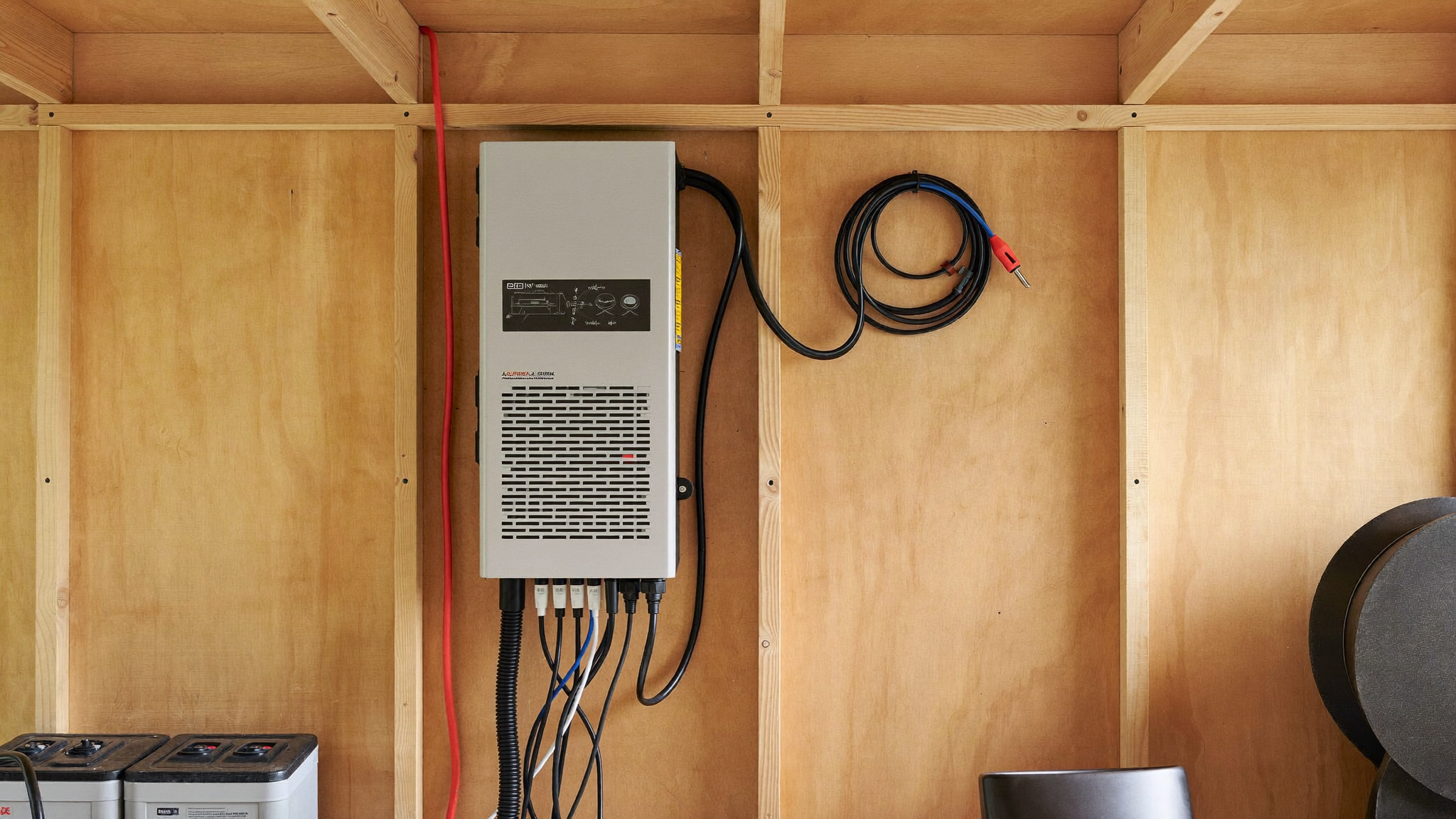
An off grid inverter is the piece of equipment that makes the rest of your system usable. Your solar panels generate DC power. Your batteries store DC power. But your refrigerator, power tools, and phone chargers all want AC. The inverter is what bridges that gap — and choosing the wrong one, or misunderstanding how it works, is one of the most common reasons off-grid systems underperform.
This article covers the mechanics, the types, the sizing process, and the details that actually matter in practice.
What an Off Grid Inverter Actually Does
At its core, an inverter takes direct current (DC) from a battery bank and converts it into alternating current (AC) that standard appliances can use. In North America that means 120V AC at 60Hz. In most of Europe and Australia, it’s 230V at 50Hz.
The quality of that conversion matters more than most people realize. Cheap inverters produce a modified sine wave — a blocky, stepped approximation of the smooth wave that comes out of a utility outlet. That works fine for resistive loads like incandescent bulbs and simple heating elements. But motors (think well pumps, refrigerator compressors, CPAP machines), anything with a microprocessor, and most modern electronics either run poorly on modified sine wave or generate excess heat doing it.
A pure sine wave inverter produces output that’s essentially identical to grid power. It costs more, but for a whole-house or serious off-grid setup, it’s the only sensible choice.
The Three Main Types
Standalone Inverters
These convert DC to AC, full stop. They don’t charge batteries, they don’t interface with solar panels directly. You’ll typically pair them with a separate charge controller and, if you want generator backup, a separate transfer switch. They’re common in simpler DIY systems where each component is sourced and sized independently.
Inverter-Chargers
An inverter-charger combines an inverter with a multi-stage battery charger. When shore power or generator power is available, it charges the battery bank and can pass that AC power through to your loads simultaneously. When external power disappears, it switches to battery. This switchover happens fast — typically under 20 milliseconds — which is fast enough that most electronics don’t notice.
For anyone running a serious off-grid cabin, a boat, or an RV where a generator is part of the picture, an inverter-charger is almost always the right call. The integration simplifies wiring considerably.
Hybrid or Multi-Mode Inverters
Hybrid inverters are designed to work directly with solar panels (or wind) on the DC input side, manage a battery bank, and interface with the grid or a generator. They’re common in solar-plus-storage installations. Some can prioritize solar, fall back to battery, then to grid — all automatically. These are more complex and more expensive, but for a full off-grid solar home, they eliminate the need for a separate charge controller.
Sizing: Where Most People Go Wrong
Sizing an off grid inverter is a two-part problem: continuous wattage and surge (or peak) wattage.
Continuous wattage is how much power the inverter can deliver indefinitely. Add up the running wattage of every appliance you might run simultaneously. Not everything you own — what you’d realistically run at the same time. A well pump, a refrigerator, some lights, maybe a microwave. That sum is your baseline continuous requirement.
Surge wattage matters because motors draw 2–6x their running wattage at startup. A refrigerator rated at 150 watts running might pull 600–900 watts for half a second when the compressor kicks on. A well pump can surge even higher. Your inverter needs to handle that surge without tripping or shutting down.
The practical rule: size your inverter’s continuous rating to meet your load, and confirm its surge rating comfortably exceeds the highest-surge device in your system. A 2,000-watt continuous inverter with a 4,000-watt surge rating handles most small-cabin scenarios. A larger homestead with a well pump, workshop tools, and a full kitchen typically needs 3,000–4,000 watts continuous with surge capacity to match.
Undersizing is the most expensive mistake. You’ll spend money on an inverter, discover it’s not enough, and spend again.
Voltage: 12V, 24V, or 48V?
Off grid inverters come in different input voltages — 12V, 24V, and 48V being the most common. This refers to the DC voltage of your battery bank, not the AC output.
12V systems are fine for small loads: a van, a small cabin with modest needs, running a few lights and charging devices. Once you start pulling 1,500 watts or more, the amperage through 12V wiring gets enormous. At 12V and 2,000 watts, you’re looking at over 160 amps on the DC side. That demands very heavy, expensive cable runs and introduces real efficiency losses.
24V systems are a reasonable middle ground for mid-sized setups.
48V systems are the standard for any serious off-grid home. The higher voltage means lower amperage for the same power output, which means thinner (cheaper) wiring, less heat, and better overall efficiency. If you’re building a whole-house system, start at 48V.
Efficiency and Idle Draw — Details That Add Up
Inverter efficiency ratings (typically expressed as a percentage, often in the 90–95% range for quality pure sine wave units) tell you how much input power becomes useful output power. A 94% efficient inverter wastes 6% as heat. Over a year, on a system running around the clock, that loss is significant.
Idle draw gets less attention but matters just as much off grid. Even with no load attached, an inverter running in standby consumes power — sometimes 10–30 watts, sometimes more. That might sound small, but 20 watts idle for 24 hours is 480 watt-hours per day. On a battery-only system, that’s real capacity being consumed doing nothing.
Many modern inverter-chargers include a search mode or power-save mode that reduces idle draw by briefly checking for a load before fully activating. It causes a very slight delay when you turn something on, but cuts idle consumption substantially.
Installation Realities
An off grid inverter lives on the DC side of your system, which means it’s dealing with high-amperage, low-voltage power — exactly the conditions where improper wiring causes fires. A few non-negotiables:
- Fuse or breaker between battery and inverter. Sized correctly for the cable, not just the inverter. This is safety-critical.
- Cable length matters. Keep DC cable runs as short as physically possible. Long runs mean resistance, voltage drop, and heat.
- Ventilation. Inverters generate heat under load. Don’t box them into an unventilated space.
- Grounding. Follow the manufacturer’s grounding instructions exactly. This isn’t optional.
Many people successfully install inverters themselves. But if your system involves whole-house loads, a generator interconnect, or utility grid interconnection, having a licensed electrician review (or complete) the AC wiring is money well spent.
Battery Chemistry Compatibility
Not all off grid inverters work well with all battery chemistries. Lead-acid (flooded, AGM, gel) and lithium iron phosphate (LiFePO4) have different charge profiles and different voltage ranges. An inverter-charger set up for lead-acid will overcharge lithium cells if you just swap batteries without reconfiguring it.
Modern inverter-chargers typically have selectable battery profiles. If you’re moving to lithium or building a lithium system from scratch, confirm the inverter you’re working with explicitly supports it and that the charge parameters are adjustable.
A Note on All-in-One Power Stations
Portable all-in-one power stations — the kind with a built-in battery, inverter, and sometimes solar input — are a different category entirely. They’re not designed for whole-house off-grid use; they’re for camping, short outages, and supplemental power. They work well for what they are, but if someone is using the term “off grid inverter” while researching a cabin or homestead system, a portable power station isn’t the answer.
The distinction matters because the two categories get conflated constantly. An all-in-one unit is a self-contained appliance. A purpose-built off-grid inverter is infrastructure — part of a larger system designed to run indefinitely.
One Thing Worth Remembering
The inverter is not where to cut corners. Panels and batteries can be upgraded incrementally. A properly sized, quality off grid inverter installed correctly — with appropriate fusing, short DC cable runs, and matched battery chemistry — will run reliably for a decade or more. A cheap undersized one will cost you twice: once to buy it, and once to replace it after it fails at exactly the wrong moment.
Leave a Reply