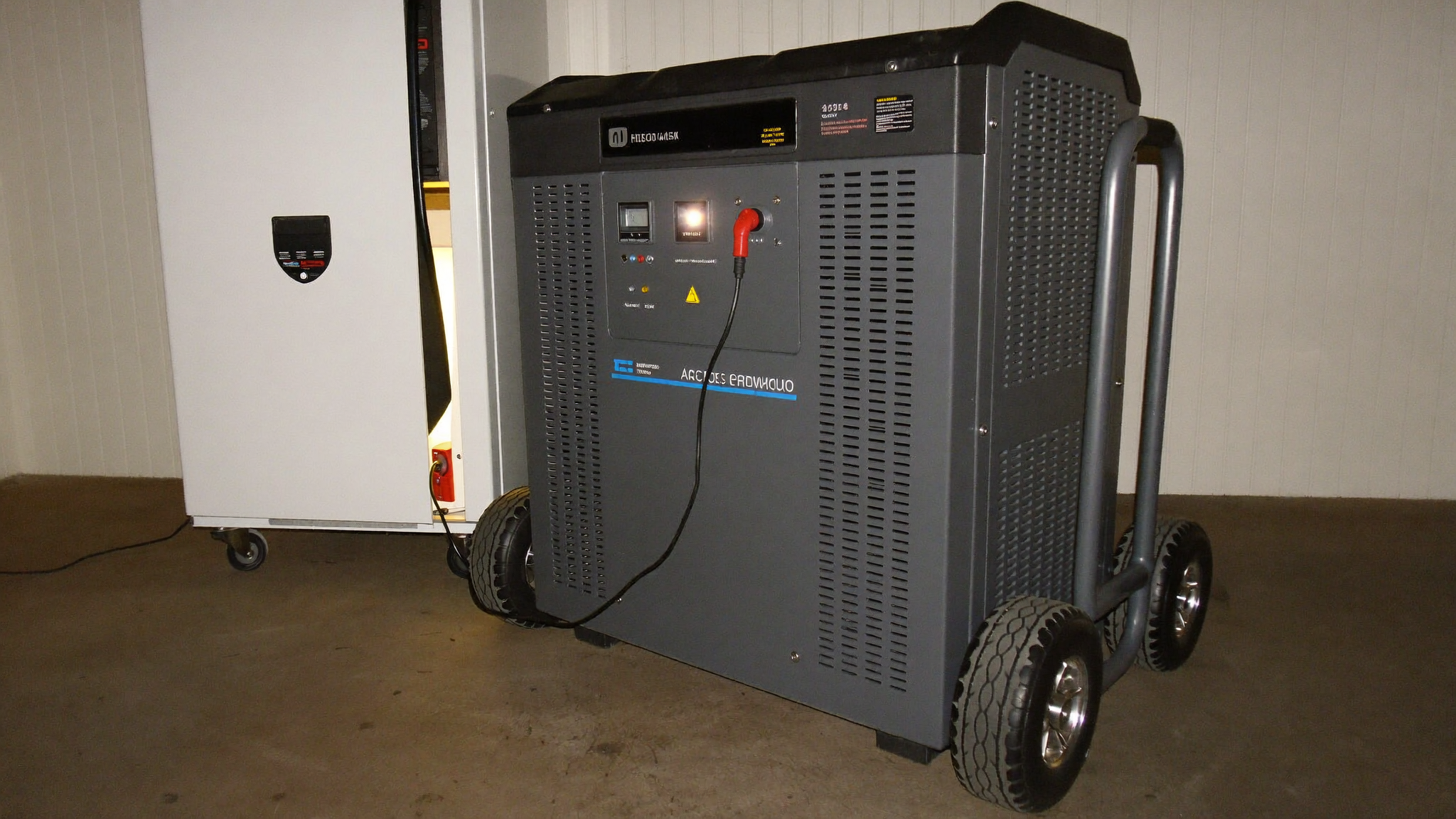
The jackery 5000 sits at the top end of what a consumer-grade portable power station can be. We’re talking about a unit with roughly 5,000 watt-hours of battery capacity — enough to run a full-size refrigerator for the better part of two days, power a window AC unit through a night, or keep a home office running through a multi-day outage without ever touching the grid. That’s not marketing language. That’s what the numbers actually support when you do the math on real-world appliance loads.
If you searched for this and aren’t sure what you’re looking at, here’s the short version: this is a large, wheeled power station designed for serious home backup, extended off-grid use, and situations where smaller 1,000–2,000 Wh units simply run out too fast.
What 5,000 Wh Actually Means in Practice
Capacity numbers are easy to misread. A 5,000 Wh battery does not mean you can run a 5,000-watt appliance for an hour — real-world efficiency losses, inverter overhead, and the unit’s continuous output wattage all factor in.
Here’s what the capacity looks like against common loads:
- Full-size refrigerator (~150W average draw): 25–30 hours of runtime
- CPAP machine with humidifier (~60W): 60+ hours
- Box fan (~50W): Several days of continuous use
- Window AC unit (~1,200W): Roughly 3–4 hours of sustained runtime
- Portable electric heater (~1,500W): 2–3 hours
- LED lighting throughout a small home: Days
The AC unit and heater numbers look low, but that’s the honest math on resistive and compressor loads. For those use cases, the value isn’t infinite runtime — it’s getting you through overnight or through a gap between generator fuel runs.
Output Wattage: The Other Number That Matters
Capacity tells you how much energy is stored. Output wattage tells you what you can actually plug in.
The jackery 5000 supports continuous AC output in the range of 3,000+ watts, with surge capacity higher than that to handle motor startups on compressors and pumps. That means it can run multiple high-draw appliances simultaneously — something smaller stations can’t touch.
For perspective: a 2,000W station would shut off if you tried to run a refrigerator, a microwave, and a few lights at the same time. At this power level, that kind of simultaneous use is no longer a problem.
Charging: Solar, AC Wall, and Car
A power station this large takes time to recharge. That’s just physics — you’re moving a lot of electrons.
AC wall charging is the fastest route. Depending on the unit’s charging rate and your outlet situation, expect anywhere from a few hours to most of a day for a full charge from empty.
Solar charging is where this class of station gets genuinely interesting for off-grid use. The jackery 5000 supports high solar input wattage — enough that pairing it with a serious array of solar panels (think four to six 200W panels) can bring the unit to a full charge in a good sun day. That changes the calculus entirely. Instead of a one-time backup reserve, it becomes a renewable daily energy supply.
Car/DC charging exists but is slow at this capacity — useful for topping off, not practical for primary charging.
One important note: check whether your specific situation supports combined charging inputs simultaneously. Some large stations allow solar and AC to charge at the same time, which can cut total charge time meaningfully.
Who Actually Needs This Much Capacity
Being honest: most people don’t. A 1,000–2,000 Wh station covers weekend camping, tailgating, van life basics, and short outages for essentials. The jump to 5,000 Wh is a significant one — in size, weight, and cost.
The jackery 5000 makes sense for:
Homeowners in Frequent Outage Areas
If you lose power two or three times a year for 12–48 hours at a stretch — from hurricanes, winter storms, or grid instability — this capacity actually pays for itself in peace of mind and avoided food spoilage alone.
Remote Cabin or Off-Grid Supplemental Power
Paired with solar panels, a station at this capacity can serve as the primary electricity source for a modest off-grid setup: lighting, device charging, a small refrigerator, and entertainment. Not whole-home replacement power, but genuine off-grid daily living.
Medical Equipment Dependence
Households where someone relies on powered medical devices — oxygen concentrators, CPAP, infusion pumps — benefit dramatically from extended runtime. The buffer this capacity provides isn’t a luxury; it’s safety.
Contractors and Remote Work Sites
Running power tools at a location without grid access is one of the original use cases for large stations. At 3,000W+ of output, circular saws, drills, and lighting all operate without issue.
Physical Reality: This Thing Is Big
This isn’t a unit you carry with one hand. The jackery 5000 weighs in at over 100 pounds, depending on configuration. It has wheels and a telescoping handle — which helps — but you’re not throwing this in a car trunk the way you would a smaller station.
Planning matters. Think about:
– Where it will live in your home (garage, closet, utility area)
– How it gets positioned near the appliances it’ll power during an outage
– Whether your vehicle can transport it if needed
The size is a genuine tradeoff. It exists because lithium battery cells have a fixed energy density — 5,000 Wh simply takes up physical space and weight. There’s no workaround.
Battery Chemistry and Longevity
Large-capacity stations at this tier typically use lithium iron phosphate (LFP) cells rather than the older lithium-ion (NMC) chemistry. LFP matters for a few reasons:
- Cycle life: LFP cells typically support 2,000–3,500 charge cycles before dropping to 80% capacity. At one cycle per day, that’s years of daily use.
- Thermal stability: LFP is significantly safer under stress, heat, and abuse than NMC chemistry.
- Longevity at partial charge: LFP handles being stored at partial states of charge better, which matters for a backup unit that might sit idle for months.
If you’re evaluating any large power station at this capacity, confirm the battery chemistry. LFP at this price point is the right answer.
Ports and Connectivity
A station this size typically ships with a full complement of outputs: multiple AC outlets (often four to six), USB-A and USB-C ports at various wattages, a 12V car-style socket, and sometimes DC barrel ports. The exact configuration varies, but at this tier you generally have enough outlets to avoid the power-strip-daisy-chain problem that plagues smaller units during outages.
Some units at this level also include app connectivity for monitoring state of charge, controlling charging schedules, and seeing real-time power draw — useful when the station is tucked in a garage and you want to check on it remotely.
A Realistic Expectation Check
The jackery 5000 is impressive hardware. It is not a whole-home generator replacement. It won’t run a central HVAC system, an electric range at full power, or an electric water heater for any meaningful duration. If those are the loads you need covered during an outage, a propane or natural gas standby generator is still the right tool.
What this station does well is cover the essentials — refrigeration, lighting, device charging, medical equipment, entertainment, fans — for extended periods, silently, without fuel, and without carbon monoxide risk. That’s a meaningful set of capabilities, and for the use cases it’s genuinely suited for, it performs them better than almost anything else in a portable form factor.
If you’re sizing up whether your needs match this capacity, sketch out your critical loads and their wattages, add them up, and estimate how many hours you’d need to run them. That math will tell you more than any spec sheet summary.
Leave a Reply