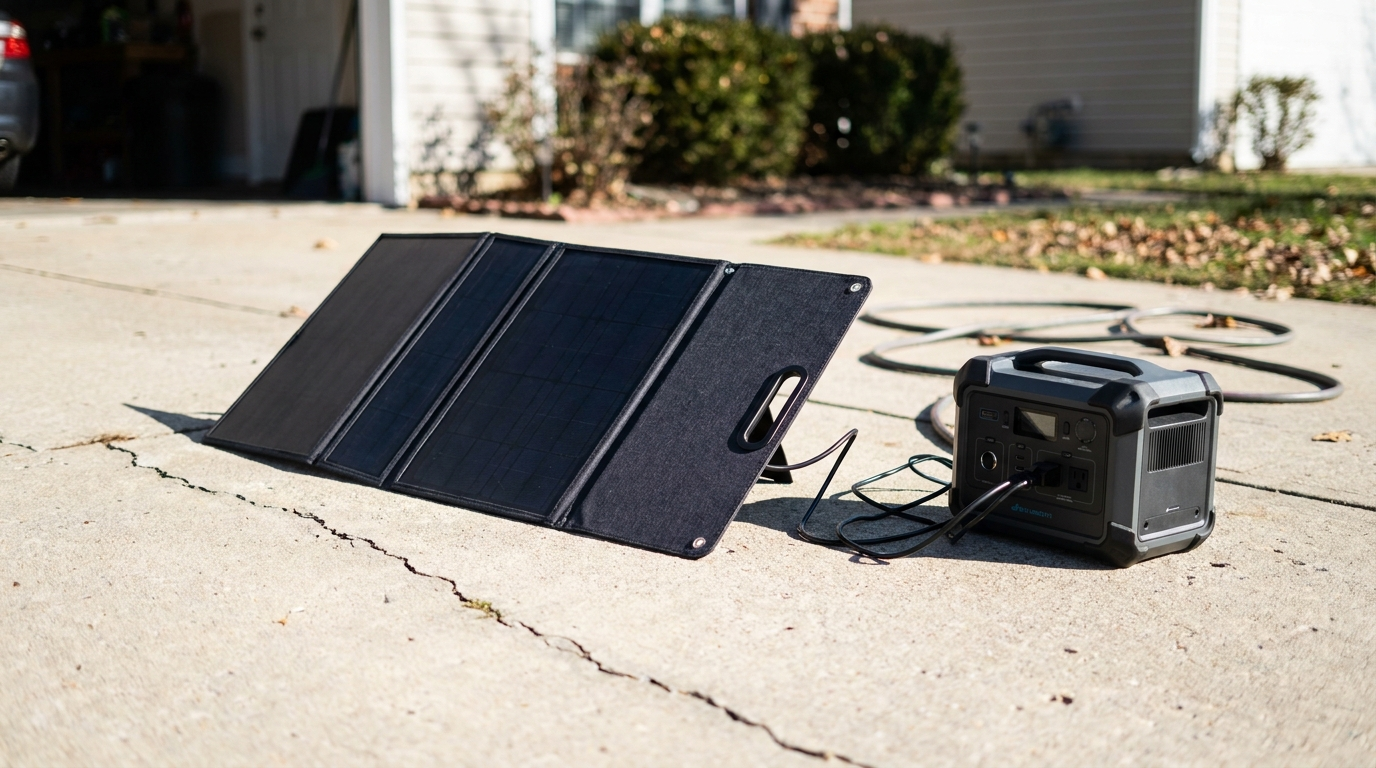
Portable Solar Electric Generator: What to Know Before You Buy
Disclosure: Some links on this site may be affiliate links, meaning we earn a small commission if you buy through them, at no extra cost to you.
A portable solar electric generator sounds simple until you’re standing in a store — or scrolling through endless product pages — trying to figure out why two units with the same advertised wattage cost completely different amounts and behave nothing alike in real use. This guide cuts through that.
The short version: most buyers focus on the wrong numbers, underestimate their power needs, and overlook a few features that make a genuine difference over years of use. Here’s what actually matters.
What a “Portable Solar Electric Generator” Actually Is
The term covers a battery-based power station combined with solar input capability — usually via XT60 or Anderson connectors accepting panels sold separately. It’s fundamentally different from a gas generator: no exhaust, near-silent operation, and a battery that can only store so much before you’ve tapped it out.
That last point trips people up. A gas generator produces power continuously as long as fuel flows. A solar system produces intermittently and stores in a finite battery. Design your expectations around that reality from day one.
The Specs That Actually Matter
Battery Capacity vs. Usable Capacity
Manufacturers list capacity in watt-hours (Wh). A 1,000 Wh unit sounds straightforward, but usable capacity depends on the battery chemistry.
- LFP (lithium iron phosphate): Runs to near-full depth of discharge, holds 2,000–3,500+ charge cycles before degrading to 80% capacity. Heavier per watt-hour, but far longer lifespan.
- NMC (nickel manganese cobalt): Higher energy density, so lighter units. Typically rated for 500–1,000 cycles. More common in budget and mid-range models.
If you’re buying for years of weekend camping, LFP wins. If you need the lightest kit for backpacking-adjacent trips, NMC’s weight advantage becomes real.
Inverter Output and Surge Capacity
The continuous output wattage tells you what the unit can run steadily. Surge capacity — often two to three times the continuous rating — tells you what it can handle for the brief spike when a motor starts.
A refrigerator compressor, a power tool, a well pump: these all draw heavy surge current at startup. Plenty of otherwise solid units will trip their protection circuits on the startup load of a mid-size chest freezer even when that freezer only draws 80W running. Always check surge specs against your highest-draw appliance’s startup requirements, not just its running wattage.
Solar Input: The Spec Everyone Underreads
Solar input wattage is usually the headline — but the input voltage range is what limits you in the field.
A unit with a max solar input of 400W sounds excellent. But if its voltage window is 12–30V, you’re severely limited in how you can wire panels. Most efficient solar panels output 35–50V open-circuit; to stay within a narrow low-voltage window, you’d need panels wired in parallel, which limits current efficiency at lower light angles.
Units with a wider input voltage range — say, 12–150V — give you far more flexibility. You can series-wire panels for better performance in suboptimal conditions, and you can use a single 200W panel efficiently rather than needing multiple smaller ones.
Also check whether the charge controller is MPPT or PWM. MPPT extracts meaningfully more power across varying conditions. Every unit worth buying today uses MPPT, but it’s worth confirming.
Sizing: The Honest Version
The most common mistake is buying too small while believing you’ve bought enough.
Here’s a rough process that works:
- List every device you might run simultaneously — not just the big ones.
- Add up their running wattage. That’s your minimum continuous output requirement.
- Find the highest single startup surge. That’s your required surge capacity.
- Estimate hours per day per device, multiply by wattage, sum the result. That’s your daily Wh draw.
- Add 30–40% buffer for inverter losses, panel inefficiency, and non-ideal charging conditions.
Few buyers regret going larger. Many regret going small.
For context: a CPAP machine without a heated humidifier runs around 30–60W. A small 12V refrigerator runs 40–60W average. A laptop charges at 45–100W. Run a fridge, a CPAP, and charge devices simultaneously through a night and a low-sun morning, and you’ll exhaust a 500 Wh unit fast.
Panel Pairing: What the Manufacturers Don’t Emphasize
The panels bundled with kits are usually acceptable but rarely optimal. Buying a portable solar electric generator as a standalone unit and sourcing your own panels often gets you better performance per dollar — especially if you need portability.
Folding/portable panels are convenient but cost more per watt than rigid panels. For a permanent truck bed or cabin setup, rigid monocrystalline panels charging the same unit deliver more power for less money.
One thing that matters more than most buyers realize: panel placement angle throughout the day. A flat panel on a sunny table underperforms a tilted panel tracking the sun by a meaningful margin — sometimes 30–40% over a full day. If you’re relying on solar recharge to run something critical, tilting and occasionally repositioning panels isn’t optional fussiness; it’s how you actually get the input you planned for.
Features Worth Paying For
Expandable battery capacity. Some units support add-on battery packs via a proprietary connection. This is genuinely useful — you can buy the base unit now and add capacity later rather than buying a new system.
Pass-through charging. Running devices while the unit charges from solar. Almost all quality units support this, but the efficiency varies. Some throttle output while simultaneously charging; others don’t.
AC charging speed. For home use and recharging before a trip, fast AC charging (800W or higher input) cuts recharge time dramatically. A unit that takes 10+ hours to refill from a wall outlet is a genuine friction point.
App connectivity. Useful for monitoring real-time input, output, and state of charge. Not essential, but the better implementations show you exactly what your panels are delivering, which helps you optimize placement and plan usage.
Build quality and heat management. Fan noise varies widely. Units designed for sustained output at high wattage manage heat better; cheap units throttle output or trip protection circuits when pushed. If you plan to run power tools or other high-draw loads for extended periods, this matters.
What to Skip
- Wireless charging pads: A minor convenience, usually slow, rarely useful as a primary feature.
- Built-in flashlights: Fine as a bonus, not a reason to choose one unit over another.
- Claimed waterproofing without IP ratings: Vague “water-resistant” language means nothing. If weather protection matters to you, verify an actual IP rating.
A Few Real-World Notes
Solar input is weather-dependent in ways that matter operationally. A 200W panel on a bright summer day with clear sky might deliver 170–185W in peak hours. The same panel on a bright but hazy day might deliver 100W. In partial cloud cover, expect 30–60W. Plan your portable solar electric generator system for worst-case charging days, not best-case ones.
Cold temperatures affect battery output noticeably. LFP chemistry is more tolerant than NMC but still loses capacity below freezing. If you’re winter camping or storing the unit in an unheated space and then expecting full performance, factor that in.
Finally: the “1,000W” inverter output and the “1,000 Wh” battery are completely separate specs. A unit with a 1,000W inverter and 500 Wh of storage can run a 500W load for roughly an hour (minus losses). Conflating those two numbers is the source of enormous buyer disappointment.
The right portable solar electric generator for most buyers lands somewhere between 500 Wh and 1,500 Wh capacity with an LFP battery, MPPT charge controller, wide voltage input range, and at least 1,000W continuous output. That range covers a camping weekend, a power outage for essentials, or a remote worksite for light tools and devices — without breaking the bank or your back carrying it.
Leave a Reply