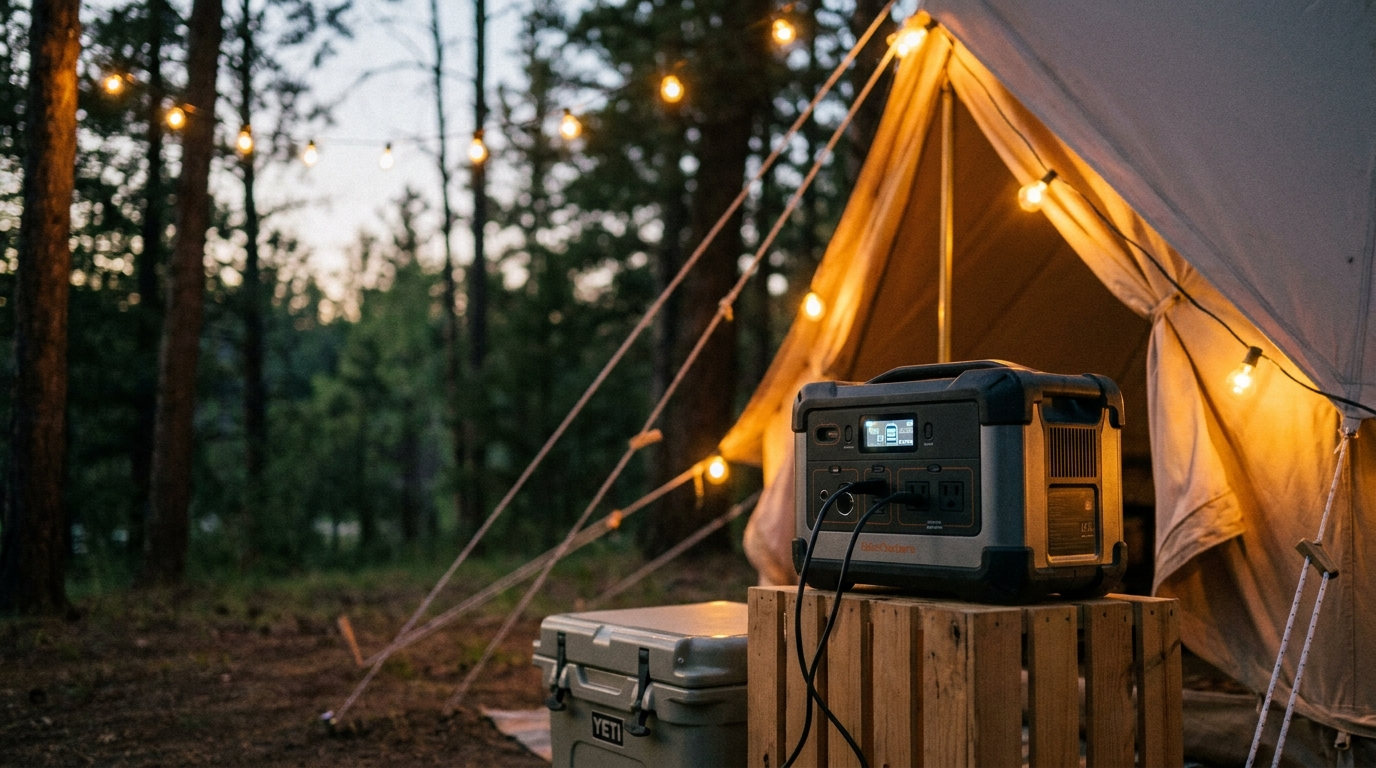
Portable Power Station for Camping: What Actually Matters
Disclosure: Some links on this page may be affiliate links, meaning we earn a small commission if you buy through them, at no extra cost to you.
Picking a portable power station for camping looks straightforward until you’re standing in the dark at a campsite because you bought the wrong one. Capacity gets all the attention in marketing, but the real-world variables—chemistry, inverter quality, charge rate, and how much weight you’re actually willing to carry—matter just as much. This guide cuts through the spec-sheet noise.
Capacity: The Number That Misleads Most Buyers
Manufacturers list capacity in watt-hours (Wh). A 1,000 Wh unit sounds like a lot until you account for conversion losses. Running an AC device means the inverter burns roughly 10–15% of that capacity just converting DC to AC. A mini fridge cycling on and off overnight can pull 300–500 Wh. Your phone, by contrast, takes maybe 15–20 Wh to charge from dead.
Here’s the practical rule: expect to use about 70–80% of rated capacity for real-world AC loads. So a 500 Wh station effectively gives you 350–400 Wh of usable energy through AC outlets. Plan around that number, not the headline figure.
Matching Capacity to Your Actual Trip
Weekend car camping with a cooler, phone charging, and some LED lights? A 500–700 Wh unit covers most people comfortably. Extend that to four days, add a CPAP machine, or bring a camp coffee maker, and you’re looking at 1,000 Wh minimum—with a solar panel to recharge during the day if you’re staying remote.
Backpacking is a different conversation entirely. Even the lightest stations in the 300 Wh range weigh around 6–7 lbs. That’s a hard ask for any trail longer than a car-to-campsite carry. For backpacking, a smaller battery bank plus a lightweight solar charger usually beats a full power station.
Battery Chemistry: LFP vs. NMC
This is where a lot of buyers leave money on the table—or overpay without needing to.
Lithium iron phosphate (LFP) cells are heavier and slightly less energy-dense, but they’re far more thermally stable, handle more charge cycles (often 2,000–3,500 before significant degradation), and tolerate being left at full charge without the same degradation issues that plague other lithium chemistries. If you’re buying a unit you’ll use for years, LFP is worth the premium.
NMC (nickel manganese cobalt) cells pack more energy into less weight and cost less per watt-hour to manufacture. For occasional campers who’ll use the unit a dozen times a year, the lower cycle count (often 500–800 cycles before hitting 80% capacity) is a non-issue. The trade-off is real, but it’s only a problem if you’re charging and discharging constantly.
The marketing materials don’t always spell this out clearly. Check the spec sheet for cycle count and look for explicit mention of LFP chemistry if longevity matters to you.
Inverter Wattage: The Spec Most People Underestimate
Capacity tells you how long. Inverter wattage tells you what you can actually run.
A 1,000 Wh station with a 600W inverter can’t run your coffee maker that pulls 900W—full stop. It’ll either refuse to start or throw an overload error. Some appliances also have high surge draw at startup (motors, compressors) that can be 2–3x their running wattage. A camping-grade 12V cooler might run at 45W but surge to 150W when the compressor kicks on.
For most camping use cases, a 1,000–1,500W inverter gives you flexibility. It handles most camp kitchen tools, a small projector, fans, and CPAP machines without drama. Stations with only 300–500W inverters are fine for charging devices and running LED gear, but frustrating the moment you try anything with a heating element or motor.
Recharging: The Overlooked Half of the Equation
Getting power into the station matters as much as what comes out, especially on longer trips.
Wall Charging
Fast charging via AC input has improved dramatically. Many newer units support 600W–1,400W input, meaning a dead 1,000 Wh station can fill in under two hours. Older or budget units might cap at 200–300W input, which means an overnight charge just to be ready the next morning. Check the input wattage, not just the capacity.
Solar Charging
Solar is genuinely useful for camping—with realistic expectations. A 100W panel in ideal conditions (direct sun, right angle, cool temperatures) might deliver 60–80W in practice. On a partly cloudy day, that drops further. To meaningfully recharge a 1,000 Wh station in a day, you generally need 200–400W of panel capacity and good sun.
Also check the maximum solar input voltage and amperage your station accepts. Some budget units have narrow MPPT windows that limit what panels you can connect. Connecting panels outside that voltage range won’t just charge slowly—it can trip protection circuits and charge nothing at all.
Car Charging
Useful for top-offs during a drive between sites. Most stations accept 12V car input at 60–120W—fine for topping up but painfully slow as a primary charging method for anything over 300 Wh.
Weight and Portability: Be Honest With Yourself
A 2,000 Wh station might sound like the obvious choice if you can afford it. But if it weighs 45+ lbs, how often are you actually hauling it from the car to a campsite table? Heavier stations often get left in the vehicle—which means running extension cords, or just not using them.
For solo or couple camping, the sweet spot is usually 500–1,000 Wh at 10–22 lbs. It’s one trip from car to site, doesn’t dominate your packing, and covers most needs. The truly massive units make sense for groups, extended basecamp setups, or overlanding rigs where the unit stays in the vehicle.
Features Worth Paying For (And Some That Aren’t)
Worth it:
– App connectivity with detailed watt readings. Seeing real-time draw by outlet is useful for trip planning and diagnosing what’s eating your charge.
– Pass-through charging that actually works without degrading the battery. Not all stations handle simultaneous input/output gracefully.
– UPS mode if you use a CPAP—some units switch to battery power in milliseconds if shore power cuts out, others have a noticeable gap.
– Multiple DC outputs including a regulated 12V port and USB-C PD. Most modern devices charge faster and more efficiently through USB-C than through USB-A.
Often not worth the premium:
– Built-in wireless charging pads. They’re slow and the convenience factor is minimal.
– Touchscreens over simple button interfaces. They look good in photos and add failure points in dusty, wet, or cold conditions.
– Extreme waterproofing ratings. IP ratings on power stations are rarely tested in genuine downpour conditions, and you shouldn’t be leaving them in the rain anyway.
Cold Weather: The Factor Nobody Warns You About
Lithium batteries lose capacity in the cold—sometimes dramatically. Below about 32°F (0°C), many LFP units drop to 70–80% effective capacity. Below 14°F (-10°C), some refuse to charge at all to protect the cells. NMC chemistry handles cold somewhat better in terms of discharge, but neither is immune.
For winter camping, keep the station inside your tent or sleeping area overnight. Don’t leave it in a cold vehicle and expect full performance in the morning. Some units have self-heating features for cold-weather charging—worth looking for if you camp in winter regularly.
Before You Buy: The Questions That Actually Matter
- What’s the heaviest single thing I need to run, and what’s its surge wattage?
- How many nights between recharges, and do I have solar or car charging available?
- Am I hauling this more than 50 feet from my vehicle?
- Do I want this to last 5+ years of regular use, or is it for occasional trips?
A portable power station for camping is genuinely useful gear—not just a gadget. But the right choice at 500 Wh is a much better purchase than the wrong choice at 2,000 Wh. Get the capacity calculation right, verify the inverter handles your loads, and match the chemistry to how often you’ll actually use it. That’s the whole framework.
See it in action
@chrismikerabe What happens when the power goes out — and you’re ready ⚡ 500W, charges phones, wifi & lights. Camping, tailgates, storm season. #portablepower #offgrid #camping #powerstation #preparedness #TikTokShop #TikTokMadeMeBuyIt
Leave a Reply