Solar Generator for RV: How to Power Your Rig Right
Disclosure: This site earns a small commission on purchases made through some links, at no extra cost to you.
A solar generator for RV camping is one of those things that sounds simple until you actually try to size one correctly. The gap between “enough power to charge my phone” and “enough power to run my 12-volt fridge through a cloudy day in the Pacific Northwest” is enormous — and most of the generic advice online glosses right over it.
This article covers what actually matters: how much capacity you need, how solar charging works in real RV conditions, where these systems fall short, and how to set yours up so it performs instead of frustrates.
What a Solar Generator Actually Is
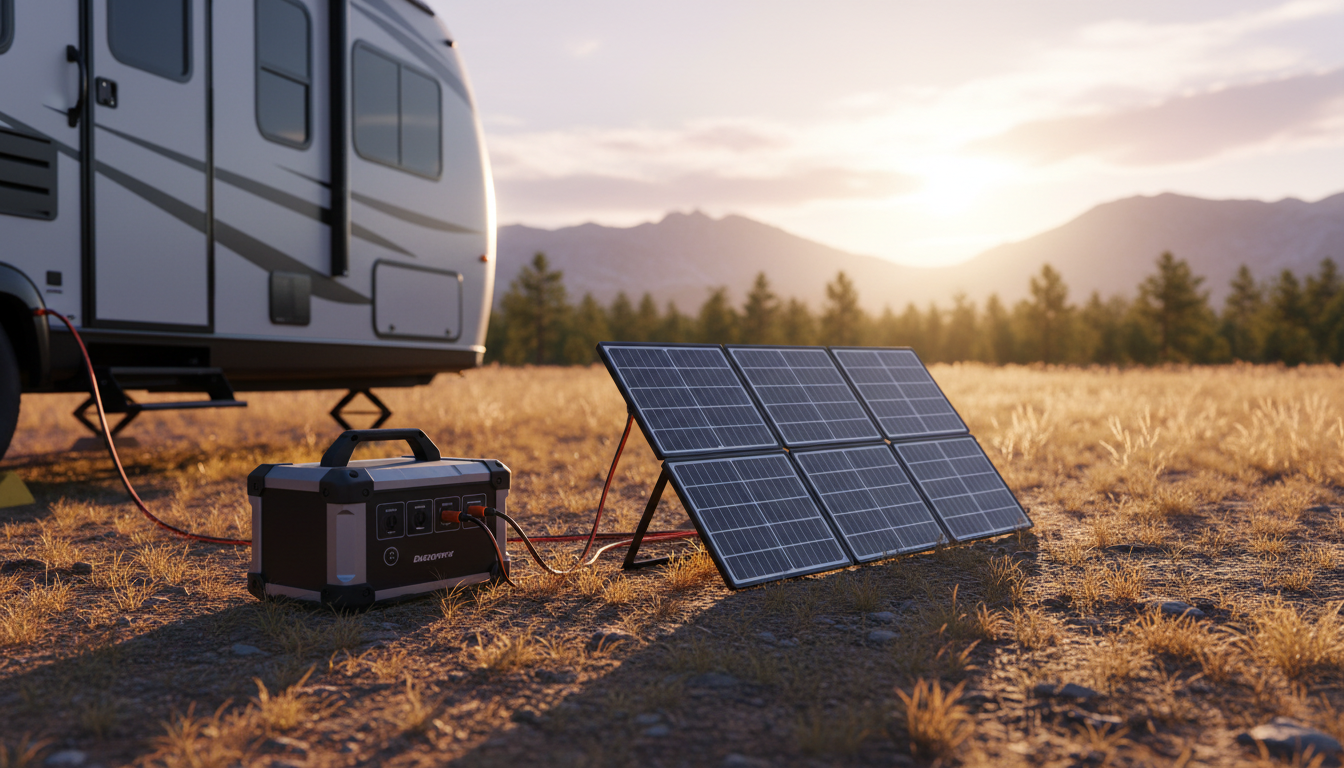
The term gets used loosely, but a solar generator is essentially a large lithium battery pack with a built-in inverter, charge controller, and AC/DC outputs — all in one box. You pair it with one or more portable solar panels, and it becomes a self-contained power system.
What it is not: a traditional fuel generator. No exhaust, no oil changes, no noise. That’s the appeal for RV use specifically. You can run it inside the vehicle, use it in campgrounds with noise restrictions, and leave it charging silently on your roof or picnic table.
The tradeoff is recharge time. A gas generator can refuel in two minutes. A solar generator depends entirely on sunlight and panel wattage.
Sizing: The Part Most People Get Wrong
This is where to spend your energy before you spend your money.
Calculate Your Daily Load First
List everything you actually run in your RV and estimate how many hours per day you use each item. A 12-volt compressor fridge is usually the biggest draw — it doesn’t pull much instantaneous wattage, but it runs a good portion of every hour. A small one might average 30–50 watts continuously. Over 24 hours, that’s 720–1,200 watt-hours just for the fridge.
Add in:
– Lighting (LED strips are efficient; 20–40W total is typical)
– Phone and laptop charging (50–100W intermittently)
– A CPAP machine if needed (variable, but significant)
– A small fan or 12V water pump
– Occasional device like a coffee maker or induction cooktop (these spike demand hard)
A realistic light-use RV setup — fridge, lights, device charging — often lands around 600–1,000 watt-hours per day. Moderate use with a laptop and fan pushes that to 1,200–1,500Wh. Running any AC or electric cooking regularly? You’re looking at a different category of system entirely.
Match Capacity to Actual Needs
Lithium battery capacity in solar generators is rated in watt-hours. But you shouldn’t plan to drain any battery to zero — that’s hard on the cells and leaves you with nothing in reserve. Planning to use about 80% of rated capacity is a reasonable approach.
For a 1,200Wh daily load, you’d want at least 1,500Wh of capacity, ideally closer to 2,000Wh if you’re spending multiple days in overcast conditions. Many of the popular mid-range units land in the 1,000–2,000Wh range. Units in the 2–3kWh range are becoming more common and more practical for extended trips.
Solar Panel Wattage: Recharge Is Everything
Here’s the honest reality of using a solar generator for RV applications: the battery size is only half the equation. If you can’t recharge fast enough, you’ll drain the battery over consecutive days no matter how big it is.
A rough rule: divide your daily watt-hour consumption by 4–5 peak sun hours (a conservative average for most of the continental US in good weather). That gives you the minimum panel wattage needed to keep up. For 1,200Wh per day, you’d need 240–300 watts of solar.
In practice, go bigger. Panels are cheap relative to batteries. A 400W panel array charges faster on good days and keeps pace on mediocre ones. Most portable solar generators accept panels up to a specific wattage input — check the maximum solar input spec before adding panels.
Real-World Conditions That Change Everything
Shade and Panel Angle
A panel producing 200W in direct noon sun might produce 60W when the sun is low or when you’re parked under trees. Partial shading on a single panel can drag down your whole array depending on how it’s wired. This is why real-world output rarely matches spec-sheet numbers.
Parking your RV facing south and tilting panels toward the sun makes a measurable difference. Even a 20-degree tilt adjustment can increase daily harvest significantly compared to flat.
Temperature
Lithium batteries charge more slowly in cold weather — some units throttle charging below 32°F or have built-in heating that consumes power. In hot weather, performance is generally fine, but keep batteries and units out of direct sun to avoid thermal management issues.
Generator Pairing
Many RVers use a solar generator alongside a small conventional generator. The solar handles the day-to-day; the gas generator tops things off when you’ve had three bad weather days in a row or need to run the AC hard. This hybrid approach is practical and removes the anxiety of relying purely on sun.
Practical Setup in an RV
Panel Options
You have two main choices: foldable portable panels or rigid panels mounted to the RV roof. Portable panels give you flexibility — you can angle them for optimal sun while the RV stays in shade. Rooftop panels are always working and require no setup, but you’re locked into whatever angle the roof sits at, and you have to run the RV to get them into sun.
For boondocking, many people run both: portable panels to maximize harvest, rooftop panels for passive charging while driving or parked normally.
Cabling and Placement
Keep cable runs short between panels and the generator — longer runs with undersized cable lose meaningful wattage to resistance. Most solar generators use MC4 connectors on their input, the same standard as rooftop solar systems, so connecting panels is straightforward.
Store the battery unit somewhere with airflow. Under a bed with the doors closed gets hot. A vented compartment or inside the living area is better.
Managing Load
The best setup in the world still benefits from load awareness. Running a high-draw appliance — an electric kettle, a hair dryer, a microwave — for a few minutes is manageable. Running it constantly is not. Knowing your appliances’ wattage and being intentional about heavy loads makes a surprisingly large difference in how long your battery lasts.
Limitations Worth Being Honest About
A solar generator for RV use has real limits. If you need to run rooftop air conditioning for hours every day in summer, you’re looking at a much larger battery and solar system than any portable unit provides — or you need shore power or a fuel generator.
Solar input is also genuinely dependent on weather. A week of heavy cloud cover in the Pacific Northwest or the Southeast monsoon season can leave you relying almost entirely on stored capacity. Either accept that limitation or plan a backup charging method.
Finally, capacity claims can be optimistic. Real-world output at high or low temperatures, at sustained loads, and accounting for inverter efficiency losses is always somewhat less than the rated spec. Factor in a 10–15% efficiency buffer when planning.
Getting the Most Out of Your System
A few habits that genuinely extend how long your charge lasts:
- Charge during peak sun hours, even partially — don’t wait until the battery is nearly empty.
- Use 12V outputs for 12V devices rather than running them through the inverter to AC; inverter conversion loses energy.
- Disable Bluetooth and app connectivity on units that support it when you don’t need it — constant wireless activity draws a small but continuous load.
- Monitor actual consumption with the built-in display rather than guessing; most modern units show real-time draw and estimated runtime.
A well-sized solar generator for RV use, paired with adequate panels and run with a little awareness, can genuinely run a comfortable off-grid setup for extended periods. The key is starting with honest math about your load, not hoping a popular model is “good enough.”
Leave a Reply